
Choosing Between Hardwood and Softwood Flooring for Your Edmonton Family Home
If you are weighing up wood flooring restoration in Edmonton for a busy family property, the hardwood-versus-softwood question is one of the first decisions worth getting right. In real homes across Edmonton, flooring has to cope with school runs, muddy shoes, pushchairs, pets, dropped toys, dining chair movement and constant traffic through halls, kitchens and living rooms. The best option is not simply the “hardest” timber on paper. It is the floor that suits the age of the property, the way your household lives, the subfloor condition, your maintenance tolerance and the finish system protecting the wood.
For many family homes, hardwood such as oak generally offers the stronger long-term balance of dent resistance, durability and resale appeal, while softwood floorboards such as pine still make excellent sense in period houses where character, repairability and authenticity matter just as much as sheer hardness. In practice, the smartest choice often comes down to this: restore existing softwood properly where the property already has original boards, or choose hardwood when installing new flooring in the most heavily used parts of the house.
At Edmonton Floor Sanding, local homeowners can choose from sanding-only, lacquered and oiled restoration options, with listed prices starting from £22 per m² for sanding only, £25 per m² for sanding plus lacquer, £26 per m² for three coats of wood floor oil and £27 per m² for sanding with two coats of hardwax oil. The site also states the company has helped over 24,000 residents since 1987, which is useful reassurance when you are choosing a floor for a hard-working family home rather than a showpiece room.
Why this question matters more in busy Edmonton homes
In family properties, floors are not judged once on installation day. They are judged every week afterwards. That is why the hardwood-versus-softwood debate cannot be reduced to appearance alone.
In Edmonton homes, the flooring in entrance areas, through lounges, dining spaces and first-floor landings often has to deal with:
- constant footfall and friction from day-to-day family use;
- small dents from toys, pet claws and furniture movement;
- spill risks from mealtimes and open-plan living;
- seasonal expansion and contraction caused by heating cycles and indoor humidity changes;
- the need for straightforward future maintenance rather than full replacement.
Because of that, the real decision is not “which wood is better?” but “which timber-and-finish combination is best for this household?”
What is the difference between hardwood and softwood flooring?
Hardwood flooring typically comes from slower-growing deciduous species such as oak, walnut, maple or ash. Softwood flooring usually comes from coniferous species such as pine, spruce or fir. Despite the names, “hardwood” and “softwood” describe botanical classification rather than an absolute guarantee of hardness. Still, in domestic flooring terms, hardwoods used for flooring are usually denser and more wear-resistant than the common softwoods found in older British homes.
That is why oak is so often recommended for family properties: it tends to cope better with repeated impact and abrasion. Softwood boards, especially original pine, mark more easily, but they also bring warmth, age, patina and heritage character that many homeowners actively want to preserve.
Hardwood flooring: the strongest all-rounder for family wear
If you are choosing a new timber floor for a busy household, hardwood is usually the more practical fit. Oak remains the standout choice for family homes because it combines structural stability, classic appearance and a dependable response to sanding and refinishing over time.
Main advantages of hardwood in a family home
- Better dent resistance: hardwood stands up more convincingly to dropped objects, toy wheels, chair legs and daily traffic.
- Longer visual lifespan: the surface tends to stay tidier for longer between major restorative work.
- Excellent refinishing value: solid hardwood can usually be sanded multiple times over its life, while quality engineered hardwood can often be refinished if the wear layer is thick enough.
- Broader finish flexibility: hardwood responds well to modern matt lacquers, satin systems and hardwax oils.
- Stronger buyer appeal: oak flooring in particular is widely seen as a premium feature.
For households with children, pets and regular entertaining, hardwood is often the lower-drama option. It will not make the floor invincible, but it does buy you more forgiveness before the room starts to look tired.
Where hardwood works best
Hardwood is especially well suited to:
- hallways and entrance routes;
- open-plan living and dining rooms;
- family lounges with frequent furniture movement;
- stairs and landings when a tougher wearing surface is needed;
- homes where future resale presentation matters.
Softwood flooring: character-rich and often the right choice for older homes
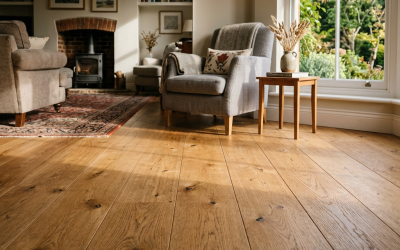
Softwood is sometimes unfairly dismissed in favour of hardwood. In truth, that misses the point of many Edmonton properties. If a home already has original pine floorboards beneath carpet or laminate, replacement is often the wrong first move. Those boards may be part of the building’s visual identity and, when restored properly, they can look superb.
Why softwood still makes sense
- Period authenticity: original pine boards suit older British housing stock far better than many modern replacements.
- Warm visual character: the grain, knots and natural tonal variation create a softer, lived-in look.
- Repair-friendly approach: individual boards can often be secured, patched or replaced with reclaimed pine rather than lifting an entire floor.
- Excellent sanding transformation: tired, painted or carpet-covered boards can often be brought back impressively.
- Lower material cost in some scenarios: especially where you are restoring what is already there.
The trade-off is simple: softwood marks faster. In a lively family home, pine will show dents, compression and movement more readily than oak. But many homeowners accept that because the floor gains character rather than looking clinically perfect. If the house suits that aesthetic, softwood can be the more honest and attractive choice.
Hardwood vs. softwood for Edmonton family life: the practical comparison
1. Durability under heavy foot traffic
Hardwood wins. In busy homes with children moving between front door, kitchen and garden-facing spaces, the additional density matters. You are less likely to see deep indentations or rapid wear in the main walking lanes.
2. Period charm and original character
Softwood wins. If the property already has original pine boards, especially in older terraces or conversions, sanding and refinishing can preserve a look that suits the building far better than installing a newer floor with a more generic finish.
3. Ease of future maintenance
This depends on the finish as much as the timber. A lacquered hardwood floor often gives strong short-to-medium-term resilience. An oiled floor, whether hardwood or softwood, can be easier to patch locally in family life because worn spots may be refreshed without always sanding the whole room. Osmo states that Polyx-Oil is dirt-resistant, water-repellent and abrasion-resistant, while also being particularly recommended for solid wood floorboards.
4. Cost-effectiveness
Restoring existing softwood often wins on cost because you avoid the upheaval and material spend of a new installation. When the boards are already in place and structurally sound, sanding, gap work and sealing can offer a much better return than replacement. Edmonton Floor Sanding’s live pricing also reinforces that restoration is usually a more affordable route than full replacement, with listed restoration packages spanning sanding-only, lacquer and oil options.
5. Best appearance after years of family use
Hardwood usually wins if you want the floor to hold a cleaner, tidier appearance over time. Softwood wins if you actively like a more relaxed, naturally aged look.
What about engineered wood?
For modern family homes, engineered wood is often part of the conversation. Technically, this is not “softwood flooring” in the same sense as pine floorboards. It is a layered construction with a real wood wear layer on top and a more stable core beneath. That can be extremely useful where subfloor movement, heating variation or installation conditions make solid timber less practical.
One important point for long-term value is refinishing potential. Recent flooring guidance notes that many engineered boards have wear layers in roughly the 2 mm to 6 mm range, and whether they can be sanded safely depends heavily on that top layer thickness. A wear layer of around 3 mm or more is commonly treated as a more realistic threshold for at least light refinishing, although the board’s condition and previous sanding history still matter.
For busy family homes, a quality engineered oak floor can therefore be a very sensible middle ground: more dimensionally stable than traditional solid boards, but still capable of looking and feeling like genuine hardwood.
The finish often matters as much as the species
In real homes, the finish system can make just as much difference as whether the timber is hardwood or softwood. A poorly finished oak floor can disappoint quickly, while a properly prepared and sealed pine floor can perform far better than many people expect.
Lacquered finish for busy households
For many Edmonton family homes, a high-performance waterborne lacquer is the strongest practical recommendation. Bona’s current technical literature states that Bona Traffic HD offers industry-leading scuff, scratch and chemical resistance, with full cure in 3 days and low-VOC technology. That makes it well suited to rooms exposed to high traffic and everyday family wear.
A lacquered system is usually the best fit where you want:
- strong resistance to routine wear;
- a finish that is straightforward to keep clean;
- lower day-to-day maintenance demands;
- a good option for halls, lounges and dining spaces.
Hardwax oil for a more natural family-friendly look
Hardwax oil is ideal where the brief is warmth, texture and easier local maintenance. It tends to suit both hardwood and restored softwood beautifully, especially if the homeowner wants a less “plastic” visual finish and a more natural timber character. Osmo’s product information highlights water repellence, dirt resistance and abrasion resistance, which is why hardwax oil remains popular on family floors where appearance and renewable maintenance are both priorities.
Which option is best for different rooms in a busy family home?
Hallways and entrances
Best choice: hardwood, ideally with a high-traffic lacquer.
This is the zone that takes the most punishment. Shoes, grit and repeat traffic call for a tougher timber and a durable finish.
Living rooms
Best choice: either can work.
If the room already has original pine boards, restoring them is often the more attractive choice. If you are installing new flooring and want longevity with children and pets, oak is usually the better investment.
Dining rooms and open-plan family spaces
Best choice: hardwood or engineered oak.
Chair movement, food spill risks and constant use generally tip the balance towards a denser timber.
Bedrooms
Best choice: softwood can make excellent sense.
Bedrooms are lower impact spaces, so restored pine can be highly cost-effective and visually warm.
Stairs and landings
Best choice: hardwood where possible, or carefully restored original timber with a robust finish.
These are impact-heavy areas and poor preparation shows quickly, so professional sanding and coating are especially important.
When restoring existing floors is the smartest option
In many Edmonton homes, the right answer is not to buy a new floor at all. It is to assess what is already there properly. Existing pine boards, parquet blocks or older hardwood planks can often be transformed through sanding, repairs, gap treatment and sealing.
The Edmonton Floor Sanding site already features local content around healthier low-VOC sanding, practical restoration advice and wooden surface refinishing, so those are useful supporting internal references when positioning this topic within the site’s existing topical cluster. See Eco-Friendly Wood Floor Sanding in Edmonton for Healthy Homes, Furious Fixes: Anger-Driven Wood Floor Restoration Tips and Worktop Refinishing in Edmonton: Refresh Worn Wooden Surfaces.
That restoration-first logic is especially strong when:
- the boards are original to the property;
- the floor has cosmetic damage rather than structural failure;
- you want better value than full replacement;
- you want to improve appearance while keeping the home’s character intact.
Our recommendation for Edmonton’s busy family homes
For most busy family households, the decision can be simplified:
- Choose hardwood if you are fitting a new floor in high-traffic spaces and want the best all-round resilience, cleaner long-term appearance and broad buyer appeal.
- Choose softwood restoration if your home already has original pine boards worth saving and you value authenticity, warmth and sensible renovation economics over a perfectly dent-resistant surface.
- Choose quality engineered oak if you need greater stability than solid timber can comfortably offer, but still want the look and feel of hardwood.
For many Edmonton homes, the winning formula is actually mixed: restore original softwood upstairs or in lower-impact rooms, and use harder-wearing timber or a tougher finishing system in the ground-floor family zones.
Frequently asked questions
Is softwood always a bad choice for homes with children?
No. It is a softer, more mark-prone choice, but restored pine can still work brilliantly in bedrooms, upper floors and period homes where original character matters.
Does hardwood need less maintenance than softwood?
Usually, yes in terms of visible wear. But maintenance still depends heavily on the chosen finish, cleaning habits and the amount of traffic the room receives.
Can original pine boards be made family-friendly?
Yes. Professional sanding, gap work, board repairs and a well-chosen finish can make original pine far more practical for modern living.
Is lacquer or oil better for a busy home?
Lacquer usually offers the strongest all-round resistance for heavy traffic. Oil offers a more natural look and simpler local maintenance. The best option depends on how you use the room.
Can engineered wood be sanded later?
Sometimes. It depends mainly on the wear layer thickness and the floor’s condition, so it should always be checked before refinishing is promised.
Final thoughts
Hardwood is usually the best technical answer for the busiest family spaces. Softwood is often the best heritage answer for older homes with original boards. The right flooring choice depends on traffic, property style, finish selection, repair needs and whether you are restoring or installing from scratch.
That is why a site visit matters. Timber species, board thickness, wear patterns, moisture conditions and subfloor stability all need to be checked before giving advice that is genuinely useful rather than generic. If you want a practical recommendation tailored to your household, visit the Edmonton Floor Sanding home page or use the contact page to arrange a quote and talk through whether your family home is better suited to restored softwood boards, new hardwood flooring or a robust refinishing plan built around the floor you already have.